 By Paul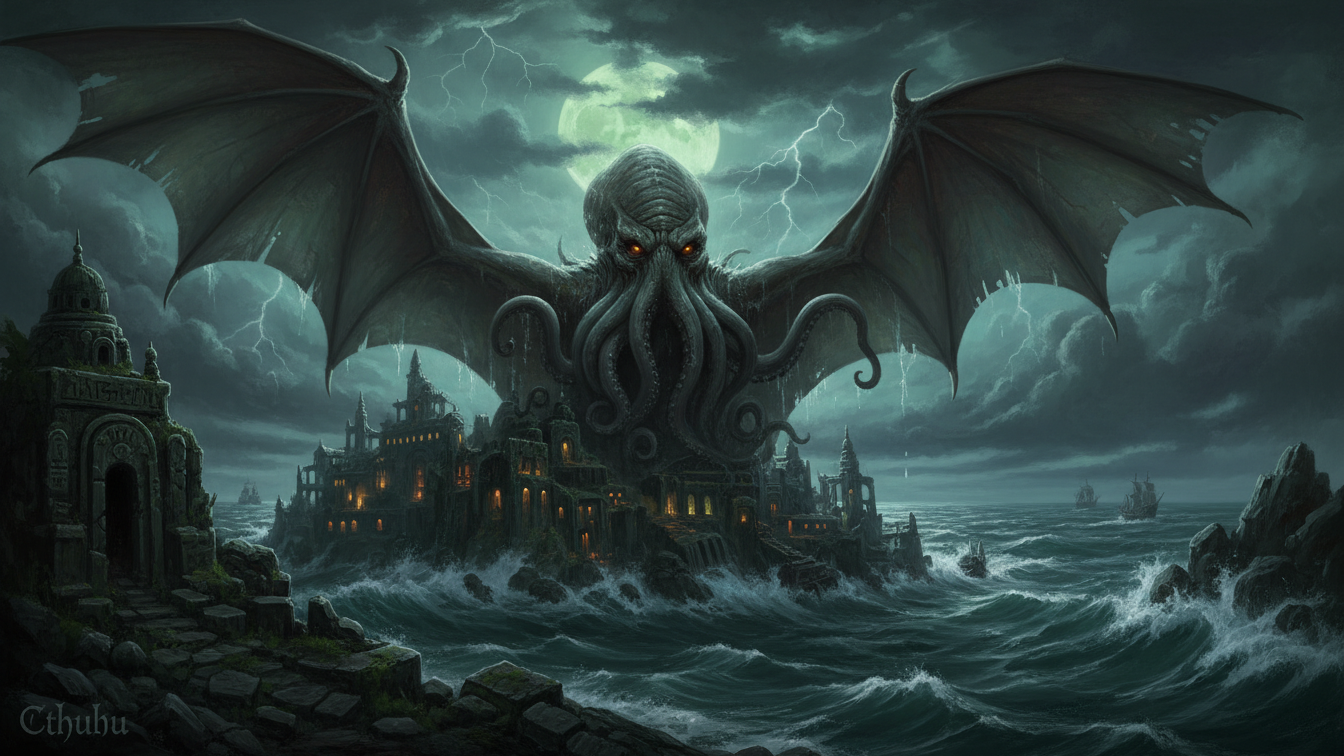
Synopsis of The Call of Cthulhu
The Call of Cthulhu is presented as a fragmented investigation pieced together from documents, testimonies, and personal experiences. Its unnamed narrator begins by reflecting on what he calls humanity’s greatest weakness: our inability to correlate all knowledge. He suggests that if humanity ever truly understood the universe, the revelation would either drive us mad or force us to flee into comforting ignorance. This philosophical framing sets the tone for the story, which concerns the uncovering of an ancient and terrifying truth hidden beneath modern civilisation.
The narrative begins after the death of the narrator’s grand-uncle, Professor George Gammell Angell, a respected scholar of Semitic languages at Brown University. While sorting through Angell’s papers, the narrator discovers a mysterious box containing strange materials: a bizarre bas-relief sculpture, newspaper clippings, handwritten notes, and transcripts of interviews. At first these seem like academic curiosities, but gradually they reveal a pattern too disturbing to ignore.
The bas-relief is described as a small clay tablet carved with an incomprehensible design: a grotesque humanoid figure with an octopus-like head, dragon-like wings, and a bloated body, surrounded by alien symbols. The sculpture was created by a young artist, Henry Anthony Wilcox, who had approached Professor Angell in 1925 seeking help interpreting disturbing dreams that compelled him to sculpt the object. Wilcox described vivid nightmares of cyclopean cities, titanic stone architecture, and a monstrous entity associated with the words “Cthulhu fhtagn.”
Intrigued, Professor Angell began recording Wilcox’s dreams and comparing them with other reports. He soon discovered that Wilcox’s visions coincided with a global wave of strange dreams, madness, and artistic frenzy occurring in the spring of 1925. Across the world, artists produced nightmarish works, mystics experienced violent revelations, and sensitive individuals reported dreams of alien cities rising from the sea. Meanwhile, the mentally ill grew more disturbed, and some died in fits of terror. When the wave abruptly ended, the dreams ceased as well.
Angell’s research leads him to investigate obscure cult activity connected to the name “Cthulhu.” Newspaper clippings describe a police raid on a secretive religious gathering in the Louisiana swamps, near New Orleans. This cult, composed of degenerate outcasts, criminals, and social rejects, worshipped a Great Old One called Cthulhu, whom they believed would one day rise from the sea and reclaim dominion over the Earth. Their chants repeated the phrase: “In his house at R’lyeh, dead Cthulhu waits dreaming.”
The police raid uncovered a disturbing idol closely resembling Wilcox’s sculpture. During interrogation, the cultists claimed their god was older than humanity, older than the Earth itself. They described a time when the Great Old Ones ruled the planet, having come from the stars, and built vast stone cities not meant for human minds or bodies. According to their beliefs, Cthulhu now lies dormant in the sunken city of R’lyeh, waiting for the stars to align so he may awaken and rise again.
One of the few intelligible cultists, an old sailor named Gustaf Johansen, told of his encounter with a monstrous island that rose suddenly from the Pacific Ocean. Though his testimony was initially dismissed as madness, it becomes the central piece of the narrator’s investigation.
Johansen’s account describes a Norwegian sailing ship, the Emma, which encountered another vessel crewed by cultists in the South Pacific. After a violent confrontation, Johansen and a few survivors found themselves adrift until they came upon a strange, newly emerged landmass. This island was composed of colossal stone structures arranged in non-Euclidean geometries—angles and perspectives that defied reason and made navigation disorienting and nauseating.
As the sailors explored the island, they accidentally opened a massive stone doorway. From within emerged Cthulhu himself: a towering, semi-corporeal being of immense size, combining cephalopod, dragon, and humanoid features. The creature exuded a sense of cosmic wrongness, as though reality itself rebelled against its presence. Several sailors were instantly killed or driven mad.
In a desperate act, Johansen rammed the creature with his ship, briefly dispersing its form. However, Cthulhu began to reassemble itself, suggesting that it could not be destroyed by human means. Johansen and one other sailor escaped, but the trauma shattered Johansen’s mind. He later died under mysterious circumstances shortly after giving his account.
The narrator concludes that Professor Angell’s sudden death—officially ruled an accident—was likely the result of foul play by cultists seeking to suppress the truth. He himself now fears that by assembling these fragments of knowledge, he has drawn dangerous attention. Yet he also believes the cult is fractured and disorganised, unable to fully awaken their god for now.
The story ends on a bleak and ominous note. The narrator is convinced that Cthulhu is not truly dead but merely dreaming, waiting beneath the ocean until the stars align once more. Humanity lives in ignorance only because it has not yet been forced to confront its insignificance. When the Great Old Ones rise again, civilisation will collapse, morality will dissolve, and mankind will be reduced to madness or extinction. The narrator resolves to keep his findings hidden, hoping that humanity’s ignorance will delay the inevitable.
Why the Story Matters
The Call of Cthulhu is foundational to Lovecraft’s philosophy of cosmic horror: the idea that the universe is vast, ancient, and indifferent, and that human beings are insignificant within it. Horror arises not from gore or violence, but from the realisation that reality itself is hostile to human meaning. The story’s fragmented structure reinforces this theme, showing how truth emerges only in glimpses—and how dangerous it is to see too much.