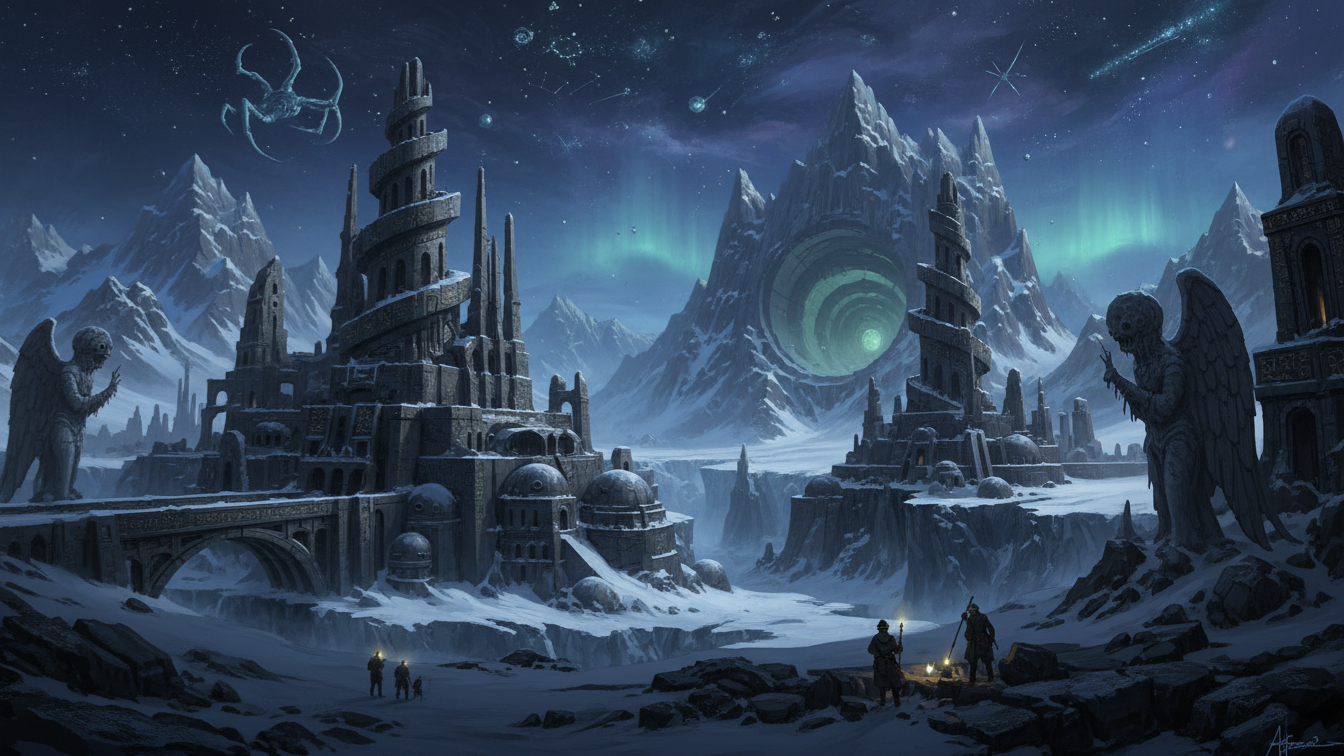
At the Mountains of Madness is a novella presented as a first-person scientific report by Dr. William Dyer, a professor at Miskatonic University. Dyer writes not to seek fame, but to issue a warning: future expeditions to Antarctica must be stopped. What he and his colleagues discovered beneath the ice revealed truths about Earth’s history so vast and horrifying that humanity, he believes, is not prepared to face them.
The story begins with the announcement of a large Antarctic expedition organised by Miskatonic University. Funded by the Nathaniel Derby Pickman Foundation, the expedition’s aim is to conduct advanced geological and biological research using drilling equipment and aircraft—technology more sophisticated than that of any previous Antarctic venture. Dyer serves as the expedition’s geologist, while Professor Lake, a biologist, leads a secondary team. The expedition establishes its main camp on the Ross Ice Shelf and begins exploratory flights inland.
During one such flight, Lake’s team discovers a strange mountain range far higher and steeper than any previously recorded in Antarctica. These peaks, black and jagged, appear utterly alien, dwarfing the Himalayas in scale and possessing an unsettling, almost unnatural geometry. Lake’s party sets up a forward camp near these mountains and begins drilling into ancient rock strata. In doing so, they uncover fossilised remains of bizarre organisms unlike any known life forms.
These creatures—later called the “Elder Things” or “Old Ones”—are barrel-shaped, starfish-like beings with multiple appendages, wings, and complex biological structures. Lake notes that they appear neither plant nor animal but something disturbingly in between. Even more shocking, the fossils seem to predate all known terrestrial life by hundreds of millions of years. Against Dyer’s cautious advice, Lake becomes increasingly excited and presses on with his investigations.
Communication between the two camps suddenly ceases. Concerned, Dyer and a graduate student named Danforth fly to Lake’s camp to investigate. What they find is a scene of devastation. The camp has been partially destroyed, several men are dead or missing, and the Elder Thing specimens—some of which were thought to be fossilised—have vanished. The bodies of the men are grotesquely mutilated, suggesting both intelligent intent and horrifying biological violence.
As Dyer and Danforth piece together what happened, they begin to suspect that some of the Elder Things were not dead at all, but merely dormant, preserved by the Antarctic cold. Revived by excavation, they appear to have attacked the camp—perhaps in self-defence, perhaps in cold, alien calculation. The sense that these beings possess intelligence, culture, and even morality—though utterly inhuman—deepens the horror.
Driven by a need to understand and by a dreadful curiosity, Dyer and Danforth decide to fly beyond the ruined camp and into the heart of the mountain range itself. Crossing the peaks, they discover a vast, cyclopean city carved from stone and partially buried under ice. The city is immense beyond comprehension, with towering blocks, strange angles, and architecture that seems to defy human notions of space and purpose. It is clearly not human in origin—and clearly ancient beyond imagining.
Exploring the city on foot, Dyer and Danforth realise that its walls are covered in elaborate bas-reliefs. These carvings tell a long, detailed history: the Elder Things came to Earth from space long before humanity existed. They created life on Earth, including primitive organisms that eventually evolved into plants, animals, and, indirectly, humans. The Elder Things built vast cities across the globe, fought wars with other alien species, and once ruled the planet as its dominant intelligent life.
Among their creations was a dangerous servant species known as the shoggoths—amorphous, shape-shifting protoplasmic beings engineered for heavy labour. Over time, the shoggoths developed a crude intelligence and rebelled against their masters. Combined with climatic changes and wars with rival alien races, this rebellion led to the gradual decline of the Elder Things’ civilisation. Antarctica, once temperate, became a frozen tomb for their last great city.
As Dyer and Danforth move deeper into the ruins, the sense of unease intensifies. Though the city appears abandoned, there are signs of relatively recent activity. Strange disturbances in the snow, damaged structures, and hints of movement suggest that not all of the Elder Things are gone—or that something else still roams the corridors beneath the ice.
Their worst fears are realised when they encounter undeniable evidence of living shoggoths. One appears in the distance, accompanied by the haunting piping cry of “Tekeli-li,” a sound that becomes synonymous with primal terror. The shoggoth is described as a vast, bubbling mass capable of forming eyes, limbs, and mouths at will—an embodiment of cosmic horror, utterly indifferent to human existence.
The two men flee in terror, barely escaping the city with their lives. During their flight, Danforth glimpses something even more disturbing—something so profoundly alien that he refuses to describe it in detail. Whatever he saw shatters his sanity, leaving him traumatised and mentally broken by the time they return to camp.
The expedition is swiftly abandoned. Dyer ensures that the scientific community hears only a sanitised version of events. In his written account—the novella itself—he finally reveals the truth, hoping to dissuade future explorers from uncovering what lies buried beneath the Antarctic ice.
The story ends not with triumph or resolution, but with dread. Humanity, Dyer concludes, is insignificant in the vast history of the cosmos. Human civilisation is a brief accident in a universe shaped by ancient, incomprehensible intelligences. Worse still, the forces that once ruled Earth may not be entirely dead—and the ice that imprisons them is not eternal.
At the Mountains of Madness is one of Lovecraft’s most fully realised works of cosmic horror. Rather than relying on sudden shocks, it builds terror through scale, deep time, and the slow erosion of humanity’s perceived importance. The true horror is not merely the monsters, but the revelation that human history, science, and religion are fragile constructs—utterly dwarfed by the indifferent universe beyond.
